another mashup of found tallava pieces.

Wednesday, July 21, 2010


Saturday, July 17, 2010
Monday, July 5, 2010
the embassy / the museum
On July 2nd we passed through metal detectors, armed guards and police cordons so that we could join the other Americans and their invited guests eating hamburgers and hot dogs. There can't possibly be a single enemy of America in Pristina, but still, because we are Americans, we must shut down the streets and divert traffic and have the utmost in security measures for an early Independence Day celebration at the museum, with an exhibition honoring the relationship between our countries.
The Kosovo constitution had been reproduced by hand to resemble its American counterpart. There were numerous ordinary items of clothing on display too, clothing that had been worn by Madeline Albright and Wesley Clark. American flags were hung side by side with Albanian flags and there were pins for Greater Albania and signs for Get Serbia Out of Kosovo, and I was embarrassed to be seen there, as if this display was making any attempt to grapple with history and truth, because it wasn't. It was only more adoration and patriotism, hamburgers and rock music.
Not that the items on display weren't historical. Many of them were. But this was a museum, and the uncritical homage seemed out of place there, like a political speech in a church, or an execution in a hospital.
I had a funny feeling as we ate hamburgers and the band played “Money for Nothing” and “One Love.” I wished I could have celebrated, because there were people present who were truly happy and truly thankful to my country. But it seemed like such a simple and stupid mistake that my country had made—to use a museum this way. The displays were perhaps even somewhat less self-analytical than those in the Military Museum of Belgrade, and I was scared that my country had really become hopeless, that we had become incapable of learning, that we would always ignore that which didn't suit our needs until it was too late, and that when real tragedy struck again here—as it had only the day before, when a pediatrician died in the streets of Mitrovica—the people from my country would only stare in wonder, dumbstruck, convinced that there was nothing they could have done better, and then go back to patting themselves on the back. I felt like I was getting dizzy, and spinning in circles, because it was me and my fellow citizens who used a museum this way; we had paid to have our praises sung, and we would probably have to pay for it again, one way or another, for years to come, because I've never yet read of self-satisfaction like this ever coming to any good.

Friday, July 2, 2010
one thing I never expected to be doing; many things I never expected to see; so much left undone
After a month or so the back seat of the car has been filled with empty plastic bottles, and then it's time to drive up into the mountains to the spring by the side of the road and fill them. We used to fill the empty bottles from the tap as reserves for those times that the water goes out. But then we saw the sediment in that water forming into brown algae-like clouds that rose to the surface of each container, and we smelled the toilet backing up through the shower drain, and we stopped trusting the tap water. We could buy it in the stores, and sometimes we do, but we try to get most of what we need from the springs, and today I went looking for one in Bajgora.
Halfway up the mountain I passed the mines, and then I entered the tunnel, slowly, because of the cows. There were four of them in there this time, one laying in the middle of the road, and the other three frantically licking the sides of the tunnel. They were pale colored, a dirty white with yellow and tan spots. Their horns flashed in the headlights, and they didn't seem to notice me as I wove between them, as if the time they spent down their had made them blind, or as if they'd been born that way, like enormous hairy albino newts in subterranean caverns. They sucked away at the slimy stone like leeches.
The spring was only a trickle, filling an enormous metal trough. Villagers passed by and said things to me. For all I know they were telling me “That spring is poisonous,” or “That's be ten dollars.” I finally found one who understood my mix of Albanian and English. He grinned and said, “Yes,” the water was good. Still, the rest of the village had so much to tell me I couldn't feel confident that I was understanding everything. Maybe I had offended them, or there was a trick to it, or maybe they just rarely had strangers up there.
I'm telling you this so you'll know how it was that I died, should I die. It was the water, from all the way up in Bajgora, that drips down across blind cow tongues, pass the entrance to the coal mines and seeps through piles of slag, into the rivers and lakes and then the pipes that empty into our sink, our toilet and tub: if I'm dead, then you'll know that the water turned out to be most deadly at its source.
Friday, June 11, 2010
Monday, May 31, 2010
24 hours, parties and people
The wedding party stepped backwards through the church doors, stopping to kiss the wooden door frame. The groom's brother threw candy and coins to us over the newlyweds' head. A man behind me began firing his weapon and the empty shells bounced off of the brick walkway and pelted my legs. The brass band doubled their volume in order to drown out their competition: a second wedding party was making their way down the hill towards us. Two local Roma girls stood to the side and waited for us to leave, eyeing the coins that we had left scattered about.
Below us apartment building walls and tin kiosks were plastered in layers of election posters. Not one of them was intact. They had all been torn, or plastered over, or defaced. I still could not remember which party was which. In the south there were new posters announcing Sunday's protest of the war veterans: this one displaying a map of greater Albania.
...
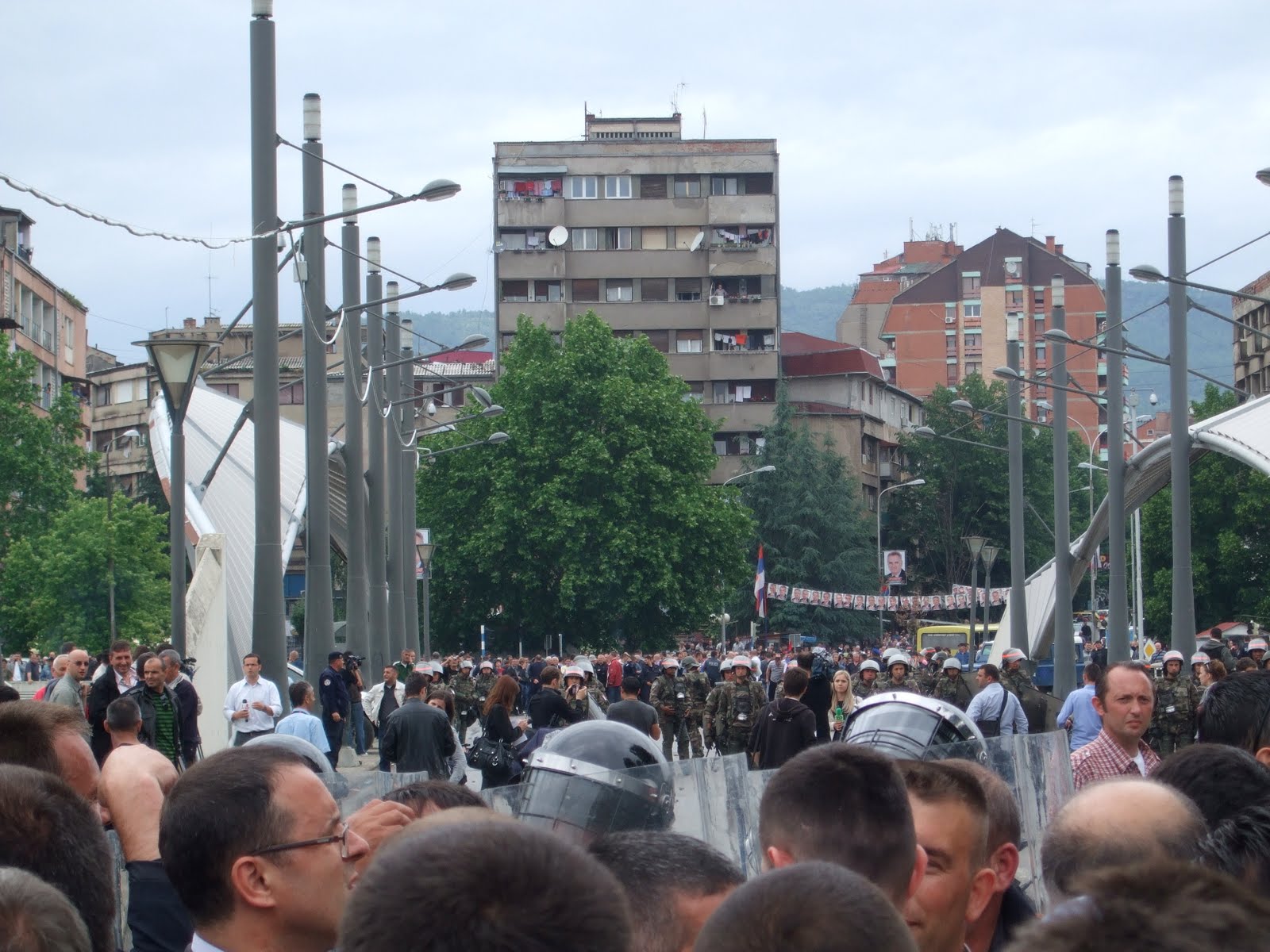
The next morning elderly people closed and shook their umbrellas as they entered the university to vote. Cars decorated in ribbons and flowers were parked outside of cafes, and gunfire celebrated more weddings. A small crowd gathered at the bridge in the north, waiting and looking south. Reporters were everywhere, and KFOR had occupied the Culure Center again. French soldiers aimed enormous camera lens at both sides. It felt like the old days.
In the south about half of the protesters were dressed in their football team's green and black in preparation for the championship game that evening. About half the crowd marched towards the park, but the other half split off and walked purposefully to the bridge. They chanted “UCK” and threw stones, and we thought that KPS or KFOR had set off tear gas, but this turned out to be fireworks from the other side. Rocks were thrown from the other side too, and a short burst of automatic gunfire sent KFOR into their tanks behind the Center. Most of the crowd in the south seemed happy and eager. A lot of people brought their small children to watch. I didn't recognize a lot of people because they had come from out of town for the protest. They tried hard to avoid stepping in the new flowerbeds that had been planted to welcome attendees of last week's “Cities in Transition” conference. We might have all come for a free concert in the park, except that a free concert would never have brought as many attendees. I was surprised by how many people were smiling and pleased. Ecstatic teens drove through the streets waving green and black flags, shouting, and honking their horns. Now the security would be higher around the bridge again, and things would be a little worse than they had been a few days before.
I figured that UNICEF ambassador Alyssa Milano's scheduled photo shoot on the bridge would be canceled. I never watched that television show when I was young, but I knew people who did. The cafes did a brisk business of old men and the security personnel of every organization in Kosovo, talking about what had and hadn't happened. The sky cleared, and they sat in the sun drinking macchiatos and smoking cigarettes.



Friday, May 28, 2010

Thursday, May 27, 2010

Friday, May 14, 2010


Thursday, May 13, 2010
leposavic, year three
Last night I went there to see a friend's band play, and we stood outside on the occasion of the Leposavic saint day, drinking Jelen out of cans and eating pleskavica out of a perfectly greasy paper wrapper. My friend's band setlist is chosen for the masses but the musicians are really top notch, including my favorite kind of bassist, perfectly in-the-pocket, dead-on drums and dueling guitarists with chops. Some of these guys would be heroes of the scene in Houston, heroes for their pure devotion to their sounds and instruments.
I've long ago gotten used to hearing thickly accented Kenny Rogers and Stevie Wonders as they might have sounded muffled and ringing harshly behind an iron curtain. Still this singer has a different problem, one of not really understanding all the words, and instead substituting wordlike phrases and sounds into lyrically critical moments, so that when he says, “Please allow me to intro doom ice elf, I'm a man of wealth and taze...” I am disappointed, yes: disappointed, and I find it hard to believe that he is anything like the devil. But this is just me, my feelings, not those of their crowd of entertainment-starved teens, and this band stood in front of the municipality building hammering out hits while five-year-olds in party dresses performed somersaults in the grass behind them, and they honored Saint Vasily Ostorzhsky with energetic performances of works by Lenny Kravitz, and Eric Clapton and other minor poets of distortion and assorted junkies, while the night previously, as has happened for more or less three hundred years, high on a cliff in Montenegro, the box containing his relics was opened and the Saint was honored for his anti-Papal fervor and Turk-evading dedication with the presentation of a new pair of shoes.
After a while we were distracted by friends, who convinced us to walk with them up those streets graffitied “New Serbia” to a club named for Belgian comic book character cowboy Lucky Luke and it was a tiny place, the walls covered in wooden beer signs like any pub in England but unusual here, and crammed with people. In the very back there were three musicians, at least I think they were musicians. The singer and guitarist might easily be mistaken for a homeless man, and the percussionist might just as easily be mistaken for a clerk at a New Age shop selling healing crystals and tarot cards, and the accordionist might simply have been a football hooligan, but they were hammering out well imagined remakings of plenty of classic material, Johnny Cash twice even, and the audience was jumping and singing along, and pretty soon so were we. This fellow's accent was strong but the words were meaningful—I agreed with him, yes, I thought: Viva Las Vegas, and this gaunt-cheeked bearded homeless man did seem to know full well what it was to have fallen into a ring of fire, and his deep understanding gave me pause during which I might be forgiven for wondering how this place came to be here, and just when Nova Serbia was founded, and where it had been for the last three years, and where I had been for the last three years too, and just how did I come to be here, in this unusual place within unusual places.
Friday, May 7, 2010
Thursday, May 6, 2010
a certain symmetry

south Mitrovica neighborhood, 2010

Orthodox baptistry in Ohrid, 5th Century

north Mitrovica neighborhood, 2010
Friday, April 30, 2010


Subscribe to:
Posts (Atom)